Is There a Cure for Tinnitus?
While no cure for tinnitus currently exists, hearing aids, sound therapy, Lenire, and stress management can meaningfully reduce how much the condition disrupts daily life.
Integrate your CRM with other tools
Lorem ipsum dolor sit amet, consectetur adipiscing elit lobortis arcu enim urna adipiscing praesent velit viverra sit semper lorem eu cursus vel hendrerit elementum morbi curabitur etiam nibh justo, lorem aliquet donec sed sit mi dignissim at ante massa mattis.
- Neque sodales ut etiam sit amet nisl purus non tellus orci ac auctor
- Adipiscing elit ut aliquam purus sit amet viverra suspendisse potenti
- Mauris commodo quis imperdiet massa tincidunt nunc pulvinar
- Adipiscing elit ut aliquam purus sit amet viverra suspendisse potenti
How to connect your integrations to your CRM platform?
Vitae congue eu consequat ac felis placerat vestibulum lectus mauris ultrices cursus sit amet dictum sit amet justo donec enim diam porttitor lacus luctus accumsan tortor posuere praesent tristique magna sit amet purus gravida quis blandit turpis.

Techbit is the next-gen CRM platform designed for modern sales teams
At risus viverra adipiscing at in tellus integer feugiat nisl pretium fusce id velit ut tortor sagittis orci a scelerisque purus semper eget at lectus urna duis convallis. porta nibh venenatis cras sed felis eget neque laoreet suspendisse interdum consectetur libero id faucibus nisl donec pretium vulputate sapien nec sagittis aliquam nunc lobortis mattis aliquam faucibus purus in.
- Neque sodales ut etiam sit amet nisl purus non tellus orci ac auctor
- Adipiscing elit ut aliquam purus sit amet viverra suspendisse potenti venenatis
- Mauris commodo quis imperdiet massa at in tincidunt nunc pulvinar
- Adipiscing elit ut aliquam purus sit amet viverra suspendisse potenti consectetur
Why using the right CRM can make your team close more sales?
Nisi quis eleifend quam adipiscing vitae aliquet bibendum enim facilisis gravida neque. Velit euismod in pellentesque massa placerat volutpat lacus laoreet non curabitur gravida odio aenean sed adipiscing diam donec adipiscing tristique risus. amet est placerat.
“Nisi quis eleifend quam adipiscing vitae aliquet bibendum enim facilisis gravida neque velit euismod in pellentesque massa placerat.”
What other features would you like to see in our product?
Eget lorem dolor sed viverra ipsum nunc aliquet bibendum felis donec et odio pellentesque diam volutpat commodo sed egestas aliquam sem fringilla ut morbi tincidunt augue interdum velit euismod eu tincidunt tortor aliquam nulla facilisi aenean sed adipiscing diam donec adipiscing ut lectus arcu bibendum at varius vel pharetra nibh venenatis cras sed felis eget.
Search "tinnitus cure" and you'll find no shortage of supplements, gadgets, and apps promising to make the ringing disappear for good. We wish we could tell you one of them works. The honest answer is that there isn't a cure for tinnitus, not yet. But that's not the whole story, and it's definitely not a reason to give up on finding relief.
Why There's No Cure (Yet)
Tinnitus isn't one condition with one cause. It's a symptom, and it can come from hearing loss, noise exposure, certain medications, or changes in how the brain processes sound. Nearly 90% of people with tinnitus also have some degree of hearing loss, which tells us a lot about what's usually driving it. When the ears send less sound information to the brain, the brain sometimes fills that gap with phantom noise. Ringing, buzzing, hissing, whatever your version sounds like.
Because so many different mechanisms can produce the same symptom, no single pill or device works for everyone. Researchers haven't found a way to reverse whatever's happening in the auditory pathway once tinnitus starts. That's the science. It's not the marketing you'll see online.
What Actually Helps
Here's the thing about tinnitus treatment: it's not about erasing the sound. It's about reducing how much it bothers you and how much space it takes up in your daily life. And for most patients, that goal is very achievable.
Hearing aids. If hearing loss is part of the picture, treating it often quiets the tinnitus too. Amplifying outside sound gives the brain something real to focus on instead of manufacturing its own noise. Many patients notice their tinnitus becomes far less noticeable once their hearing aids are properly fitted.
Sound therapy. Steady background noise, whether it's white noise, nature sounds, or fractal tones, can take the edge off. It doesn't cure anything, but it gives the brain competing input, which makes the tinnitus less prominent, especially at night.
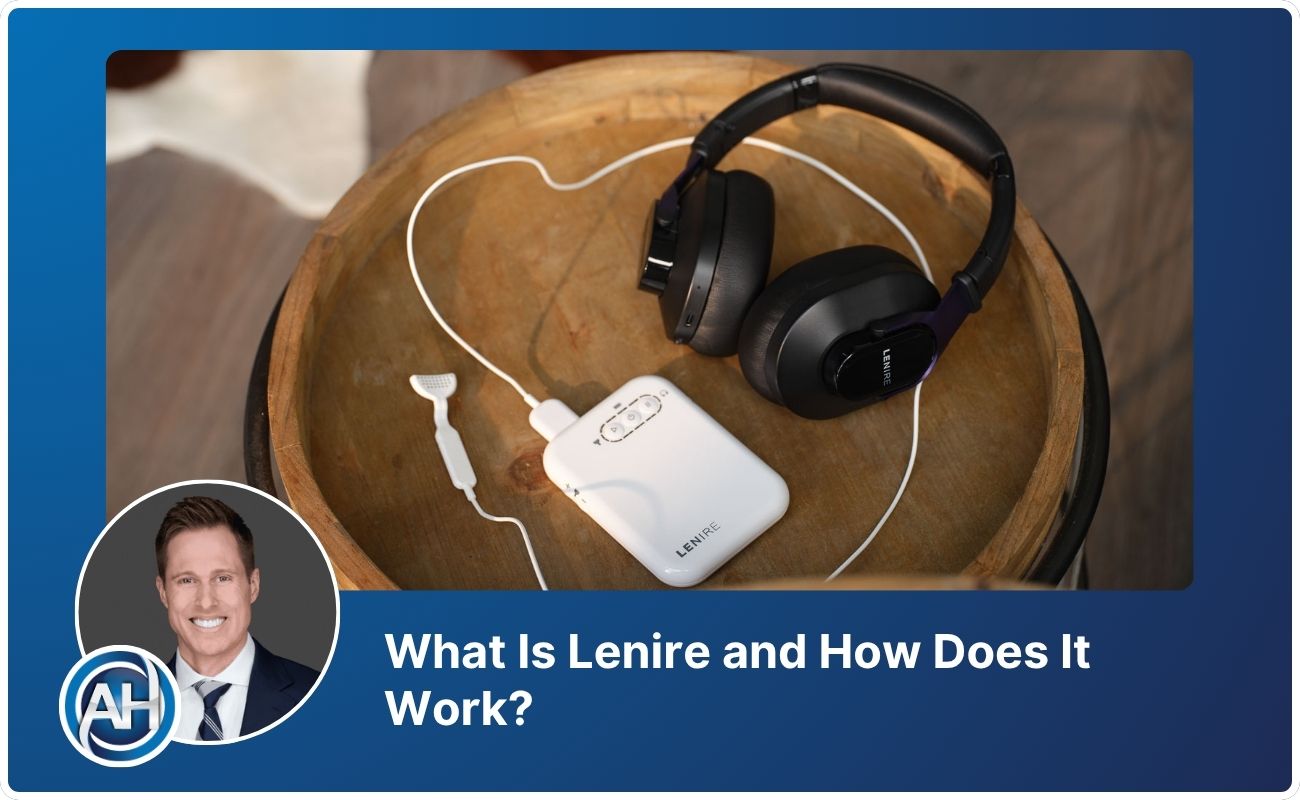
Lenire. This is one of the more promising developments in recent years. Lenire is a bimodal neuromodulation device that pairs mild tongue stimulation with sound delivered through headphones. It's not for everyone, and it requires a formal evaluation to see if you're a candidate. But for the right patient, it can meaningfully reduce tinnitus severity over a course of treatment.
Counseling and stress management. Tinnitus and stress feed each other. The more anxious you feel about the sound, the louder it seems. Techniques like cognitive behavioral therapy, meditation, or simply learning how the brain processes tinnitus can shift how much it affects you, even when the sound itself doesn't change.
None of these approaches promise silence. What they offer is something more useful: a life where tinnitus stops being the loudest thing in the room.
What to Watch Out For
If a product claims it will eliminate tinnitus permanently, that claim isn't backed by research. Be skeptical of supplements promising a fix, "miracle" ear drops, or gadgets sold without any clinical evaluation behind them. The safest first step is always a professional assessment, not a cart checkout.
Getting an Accurate Picture of Your Tinnitus
Tinnitus management starts with understanding what's actually happening in your ears and brain. A comprehensive hearing evaluation, along with a tinnitus pitch and intensity match, gives us the information we need to figure out which combination of treatments makes sense for you. Sometimes that means hearing aids. Sometimes it's Lenire. Often it's a mix of approaches tailored to your specific symptoms and lifestyle.
Find Tinnitus Relief in Phoenix or Scottsdale
At Applied Hearing Solutions, we don't sell false hope, and we won't tell you we can cure something that can't be cured. What we can do is help you find real, lasting relief through evidence-based treatment built around your specific situation. Our audiologists take the time to understand your tinnitus, not just mask it.
Our Scottsdale location has a dedicated tinnitus specialty and is Scottsdale's only Lenire partner clinic, so if you've heard about Lenire and want to know if you qualify, that's the place to start. Call us at 480-447-9434 to schedule a consultation there.
If you're closer to our north Phoenix office, we offer the same thorough tinnitus evaluations and treatment planning. Reach us at 602-877-0000 to get started.
Tinnitus doesn't have to run your life. Let's find out what will actually help yours.