What Is Lenire and How Does It Work?
Lenire is an FDA-authorized tinnitus device that pairs sound with mild tongue stimulation to reduce ringing through bimodal neuromodulation.
Integrate your CRM with other tools
Lorem ipsum dolor sit amet, consectetur adipiscing elit lobortis arcu enim urna adipiscing praesent velit viverra sit semper lorem eu cursus vel hendrerit elementum morbi curabitur etiam nibh justo, lorem aliquet donec sed sit mi dignissim at ante massa mattis.
- Neque sodales ut etiam sit amet nisl purus non tellus orci ac auctor
- Adipiscing elit ut aliquam purus sit amet viverra suspendisse potenti
- Mauris commodo quis imperdiet massa tincidunt nunc pulvinar
- Adipiscing elit ut aliquam purus sit amet viverra suspendisse potenti
How to connect your integrations to your CRM platform?
Vitae congue eu consequat ac felis placerat vestibulum lectus mauris ultrices cursus sit amet dictum sit amet justo donec enim diam porttitor lacus luctus accumsan tortor posuere praesent tristique magna sit amet purus gravida quis blandit turpis.

Techbit is the next-gen CRM platform designed for modern sales teams
At risus viverra adipiscing at in tellus integer feugiat nisl pretium fusce id velit ut tortor sagittis orci a scelerisque purus semper eget at lectus urna duis convallis. porta nibh venenatis cras sed felis eget neque laoreet suspendisse interdum consectetur libero id faucibus nisl donec pretium vulputate sapien nec sagittis aliquam nunc lobortis mattis aliquam faucibus purus in.
- Neque sodales ut etiam sit amet nisl purus non tellus orci ac auctor
- Adipiscing elit ut aliquam purus sit amet viverra suspendisse potenti venenatis
- Mauris commodo quis imperdiet massa at in tincidunt nunc pulvinar
- Adipiscing elit ut aliquam purus sit amet viverra suspendisse potenti consectetur
Why using the right CRM can make your team close more sales?
Nisi quis eleifend quam adipiscing vitae aliquet bibendum enim facilisis gravida neque. Velit euismod in pellentesque massa placerat volutpat lacus laoreet non curabitur gravida odio aenean sed adipiscing diam donec adipiscing tristique risus. amet est placerat.
“Nisi quis eleifend quam adipiscing vitae aliquet bibendum enim facilisis gravida neque velit euismod in pellentesque massa placerat.”
What other features would you like to see in our product?
Eget lorem dolor sed viverra ipsum nunc aliquet bibendum felis donec et odio pellentesque diam volutpat commodo sed egestas aliquam sem fringilla ut morbi tincidunt augue interdum velit euismod eu tincidunt tortor aliquam nulla facilisi aenean sed adipiscing diam donec adipiscing ut lectus arcu bibendum at varius vel pharetra nibh venenatis cras sed felis eget.
If you've spent any time researching tinnitus treatment, you've probably come across the name Lenire. It's an FDA-authorized tinnitus treatment device, and it's generating a lot of questions from patients who are tired of ringing, buzzing, or hissing that won't quit. So what is it, exactly, and does it actually work? Here's what the research shows and what to expect if you're considering it.
What Lenire Is
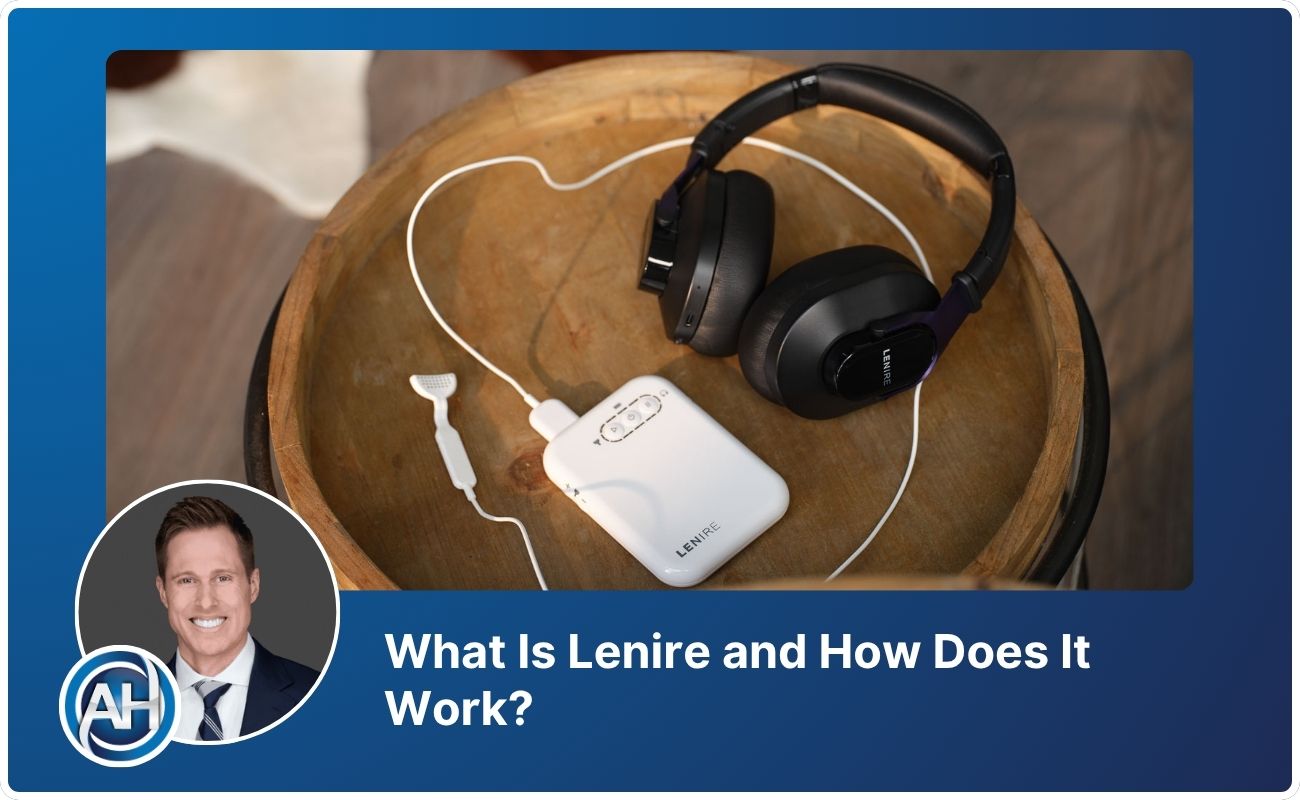
Lenire is a medical device developed by Neuromod Devices for the treatment of tinnitus. It uses something called bimodal neuromodulation, which just means it stimulates the brain through two senses at once instead of one. Most tinnitus tools rely on sound alone. Lenire pairs sound delivered through Bluetooth headphones with mild electrical stimulation delivered to the tongue through a small device called Tonguetip.
The idea behind this comes from research suggesting the brain's auditory pathways can be influenced by stimulating other sensory nerves at the same time. Tinnitus is often linked to overactive or miswired neural circuits, not damage you can point to on a scan. Bimodal stimulation is designed to encourage those circuits to settle down and become less reactive.
Where the Research Comes From
Lenire didn't arrive on the market on a marketing claim alone. It went through three major clinical trials, known as TENT-A1, TENT-A2, and TENT-A3.
TENT-A1 was the first large-scale trial, designed to test whether bimodal stimulation was safe and effective across a broad range of tinnitus patients. TENT-A2 built on those results by optimizing the device's settings, fine-tuning how the sound and tongue stimulation should be timed and combined for the best result. Together, those two trials enrolled 517 participants and measured outcomes using validated tools like the Tinnitus Handicap Inventory. The results were promising enough to move forward with a confirmatory trial designed specifically for FDA review.
That trial was TENT-A3. It enrolled 112 participants, who used sound-only stimulation for six weeks and then had tongue stimulation added for a second six weeks, with each participant serving as their own control. Among participants with moderate or worse tinnitus, bimodal treatment produced a meaningfully higher response rate than sound alone (58.6% compared to 43.2%). And among participants with moderate or worse tinnitus who saw no meaningful improvement from sound alone, 70.5% reported clinically significant improvement once tongue stimulation was added. That distinction matters. It's not just "sound helps," it's that adding the tongue stimulation component made a measurable difference for people whose tinnitus was significantly affecting their life.
Based on those results, Lenire received FDA De Novo marketing authorization in March 2023, making it the first and only FDA-authorized bimodal neuromodulation device for tinnitus in the United States. It's a prescription device for adults 18 and older with at least moderate tinnitus.
Does Lenire Work for Everyone?
Here's where we want to be honest with you. No tinnitus treatment works for everyone, and Lenire is no exception. The trials showed the strongest benefit in people with moderate or worse tinnitus severity. Response also varies from person to person, which is true of nearly every tinnitus treatment on the market.
What the research does support is this: for a meaningful portion of patients, especially those whose tinnitus is disruptive enough to affect sleep, focus, or mood, Lenire produced real improvement. In the two earlier trials, participants were followed for 12 months after treatment ended and many of those who used the device consistently held onto their gains. It's worth noting that those earlier trials were not part of the data the FDA reviewed, which was based on TENT-A3. The FDA authorization itself is worded around temporary relief of symptoms, so that's the honest frame.
We'd rather give you an accurate picture than an inflated one. Lenire is a well-studied option but it's not a guaranteed cure.
Who Should Consider Lenire
Tinnitus has a long list of possible contributing factors, from hearing loss to medication side effects to unrelated medical conditions. Lenire is intended for adults with subjective tinnitus of at least moderate severity, and it isn't appropriate for everyone. For example, people with a pacemaker, defibrillator, or other active implanted device shouldn't use it unless directed by a physician.
Before anyone starts a treatment like Lenire, it matters to understand what's actually going on with your hearing and your tinnitus profile. A hearing evaluation, along with a tinnitus pitch and intensity match, gives your audiologist the information needed to figure out whether bimodal neuromodulation is a reasonable fit for your specific situation, or whether another approach makes more sense.
That evaluation is the step we always recommend first, before anyone commits time or money to a device.
Lenire Treatment at Our Scottsdale Clinic
We're proud to be a Lenire partner clinic in Scottsdale, and tinnitus care is a specialty at that location. If tinnitus has been running your life and you want to know whether Lenire could help, the best next step is a comprehensive evaluation with one of our audiologists. We'll walk you through your results, talk honestly about what to expect, and help you decide on a path forward that actually fits your situation.
Give us a call at 480-447-9434 to schedule a consultation at our Scottsdale office. You don't have to keep living with the noise, and you don't have to guess your way through treatment options either.